
February Books
Marcel Proust, Michael Mann & Meg Gardiner, Laura Andrea Garzón

Swann’s Way (1913), by Marcel Proust, translated from the French by C. K. Scott Moncrieff and Terence Kilmartin (1922, 1981)
I was hoping to read more books in February, and to come out with two newsletters instead of just one, but this was such a slog for me that I couldn’t do it. It truly felt like the literary equivalent of eating my vegetables. The purpleness and density of the prose just gave me such little to hold onto as a reader, and I found my mind wandering elsewhere every other sentence.
The narrative itself, when Proust felt like advancing it, kept me going. There is something vaguely thrilling in Swann’s romance with Odette, in the way all the characters navigate and wield the moral strictures of the Parisian bourgeoisie to ostracize and judge rivals, forgive friends, and pursue their own desires, however taboo. The characters are memorable, for me none more so than the narrator’s sickly aunt, bedridden and cloistered in her home, yet still the consummate busybody, using her loyal servant as her tether to society and its gossip.
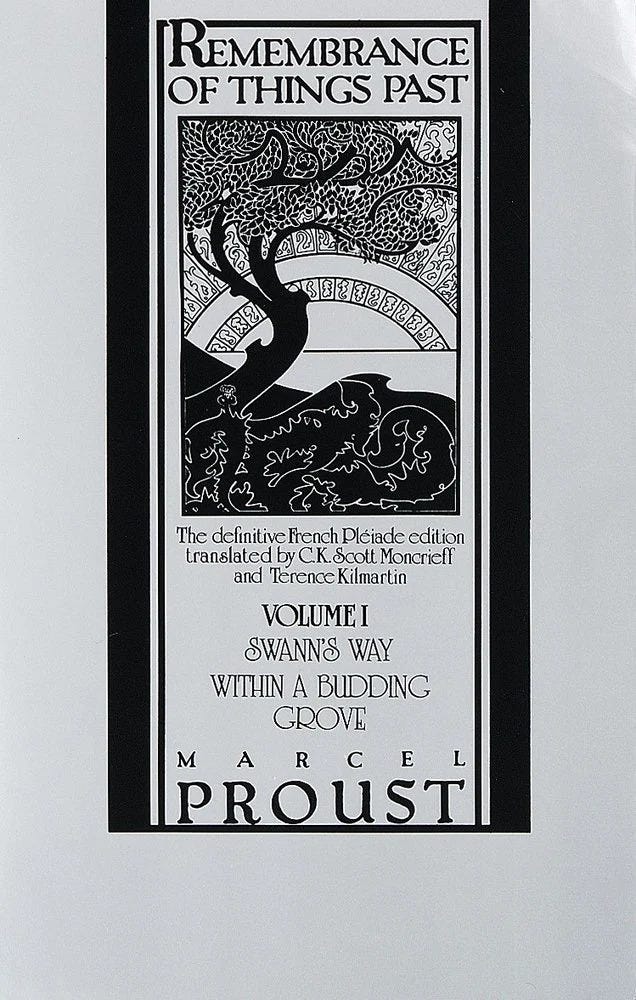
The problem for me, however, is the number of books that do this sort of thing are a plentiful, and I care far less about what a book has to say and far more about the way it says it. The endless lyrical digressions on the particular aesthetic qualities of, say, a tree in spring in Combray leave me rather cold. The book is just one soporific scene like this after another:
But it was in vain that I lingered beside the hawthorns—inhaling, trying to fix in my mind (which did not know what to do with it), losing and recapturing jtheir invisible and unchanging odour, absorbing myself in the rhythm which disposed their flowers here and there with the lightheartedness of youth and at intervals as unexpected as certain intervals in music—they wen on offering me the same charm in inexhaustible profusion, but without letting me delve any more deeply, like those melodies which one can play a hundred times in succession without coming any nearer their secret. I turned away from them for a moment as to be able to return to them afresh. My eyes travelled up the bank which rose steeply to the fields beyond the hedge, alighting on a stray poppy or a few laggard cornflowers which decorated the slope here and there like the border of a tapestry whereon may be glimpsed sporadically the rustic theme which will emerge triumphant in the panel itself; infrequent still, spaced out like the scattered houses which herald the approach of a village, they betokened to me the vast expanse of corn beneath the fleecy clouds, and the sight of a single poppy hoisting upon its slender rigging and holding against the breeze its scarlet ensign, over the buoy of rich black earth from which it sprang, made my heart beat as does a wayfarer’s when he perceives upon some low-lying ground a stranded boat, which is being caulked and made sea-worthy, and cries out, although he has not yet caught sight of it, “The Sea!”
Perhaps it is a personal failing or reveals a discomfort with a certain kind of writing, but as a reader, I was constantly missing the forest for the too richly detailed trees.
Heat 2 (2022), by Michael Mann and Meg Gardiner
If Proust was an overdose of vegetables, this was dessert. The book is almost exactly as long as Swann’s Way, if you go by page count, but boy does it read quicker. It retains the rhythm that made the original movie feel way shorter than its 3 hour run-time. Heat 2 is both a prequel and a sequel to Mann’s 1995 film. It flashes back to Vincent Hanna (Al Pacino), Neil McCauley (Roberto DeNiro), and crew plying their trade in Chicago and on the U.S.-Mexico border. It advances the timeline forward, to Chris Shiherlis (Val Kilmer) hiding out in Ciudad de Este, Paraguay, starting over as a henchman for a Taiwanese-Paraguayan crime family. Holding past and future together in an ever-changing cat-and-mouse game is a new character, Otis Wardell, a violent psychopath and sex criminal. At one point or another, McCauley and Shiherlis, Hanna, and Wardell all hunt one another.
It is hard not to compare this book to the original film, and having just rewatched it a few days ago, it’s not necessarily a comparison that flatters the book. It’s a fine effort, but I think the ending of Heat left Mann and Gardiner with a few insurmountable problems to overcome in writing Heat 2, and some of their solutions didn’t quite work for me.
First and foremost, the best part of the movie is the dynamic between Hanna and McCauley. Shiherlis is, at best, the third most interesting character in the movie, and if he is, it is a distant third. Mann likely knows this, so what we get in Heat 2 is essentially a prolonged training montage in Paraguay in which Shiherlis slowly but surely becomes McCauley. He quits gambling and drugs, he buckles down and focuses, and by the end he is no longer a passenger in his own life but someone with ambitions and ideas.
And with Shiherlis in South America and Hanna still a detective with the LAPD, there is no sense of the hunt that put things in constant motion and gave Pacino a hamster wheel to run on. Mann solves this problem by essentially transposing the soul of Waingro, the serial killer and rat who is kicked out DeNiro’s crew, into Wardell and making him a major character. Wardell and Waingro are pure evil, and characters who are pure evil are simply not that interesting. Waingro’s presence in Heat is minimal, Wardell is a load-bearing element of Heat 2.
And then there are issues of medium, of things maybe not working the same way in novels as they do in film. The frisson of watching a competent crew of professional criminals execute a perfectly planned heist doesn’t translate as vividly to the page. To get the reader’s heart rate going, I get the sense that Mann and Gardiner leaned more into violence in Heat 2, and to scenes of torture and sexual violence. I found this to be a regrettable choice, slightly lurid and cheap, and it strays a little too far from what made the original movie great.
And then finally, there is the impossibility of translating a performance like Pacino’s to the page. In Heat, during Hanna’s brief moments of silence, you do not know his thoughts. You can guess at them and try to read them in his twitchy intensity, but you do not get to witness the mental alchemy that results in lines like this:
That gonzo delivery of Pacino’s simply cannot be translated to the page, no matter how many strategic italics you deploy. None of Hanna’s dialogue in Heat 2 holds a candle to his lines in the movie. He practically has a catchphrase in the book, ambushing criminals with “April Fool’s, motherfucker!” on more than one occasion. It feels a little half-baked. There are a few good attempts though, and I’ll end my thoughts here, with the book’s best approximation of a classic Vincent Hanna line:
“You don’t get it,” Alex tries.
“Get what? We don’t gotta get nothin’. Light bulb on yet? Anyone home in that dark, cobwebbed place known as your cerebral cortex?”
“What Kotex?” Alex says.
“Kotex is what ladies put between their legs. Cortex is upstairs.”
Pan Piedra (2022), by Laura Andrea Garzón
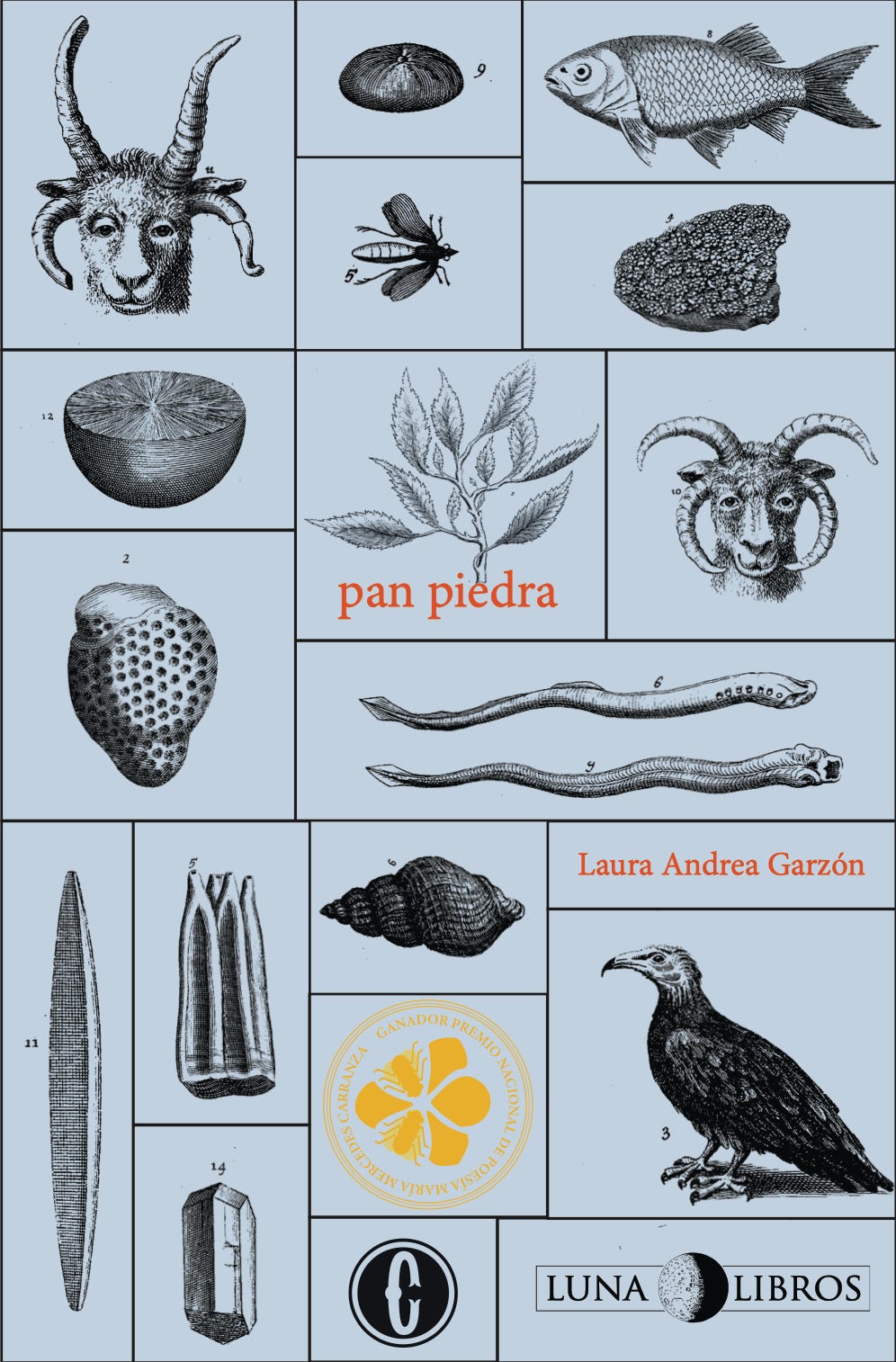
In February I also read — and have been slowly translating for my own personal enrichment — this book of poetry that I picked up from bookstore in Medellín a year or two ago. The poems within create a larger narrative, a kind of creation story within quotidian childhood and domestic scenes set in Bogotá. I like the plain-spoken language, with its familiar turns of phrase that feel cozy and comfortable:
En el principio ya estaba todo

La humedad que no sabe si es frio o es agua
y la sequedad que quiebra los labios
                                                      la boca abierta para respirar
ahí          donde el aire siempre es poco

Dioselina mira por la ventana de su casa en el barrio Quiroga
   en la ciudad de Bogotá. Desde la terraza
   le parece que es bueno estar ahí
   en la casa que ha construido con el trabajo
   sudor en la frente y perserverencia porque ese
                                                            es el orden de la cosas
which, in my very rough draft of an English translation, becomes:
In the beginning everything was already there

The humidity that doesn't know if it is cold or water
the dryness that splits lips
                                        the mouth open to breath
there        where the air is always thing

Dioselina looks out the window of her house in the Quiroga neighborhood
   in the city of Bogotá. From the patio
   she thinks it is good being there
   in the house she has built with the sweat
   of her brow and persistence because that
                                                  is the way things are
Perhaps, if I continue to translate this I’ll include more in future newsletters
The On-Deck Circle:
Apologies if reading about these three very different works gave you whiplash, reading some of them certainly left me with some aches and pains. The next several books should be a bit more tonally consistent, as they will all be from my book club subscriptions:
From Archipelago:
A Parish Chronicle, by Halldór Laxness
Queen, by Birgitta Trotzig
From NYRB:
The Lord, by Soraya Antonius
Friday, by Michel Tournier
The Universal Baseball Association, Inc. J. Henry Waugh, Prop., by Robert Coover
From New Directions:
The Disappearing Act, by Maria Stepanova
Lithium, by Malén Denis