
June Books
Charles Portis, Gabriela, Wiener, Alejandro Zambra, Anne Rice

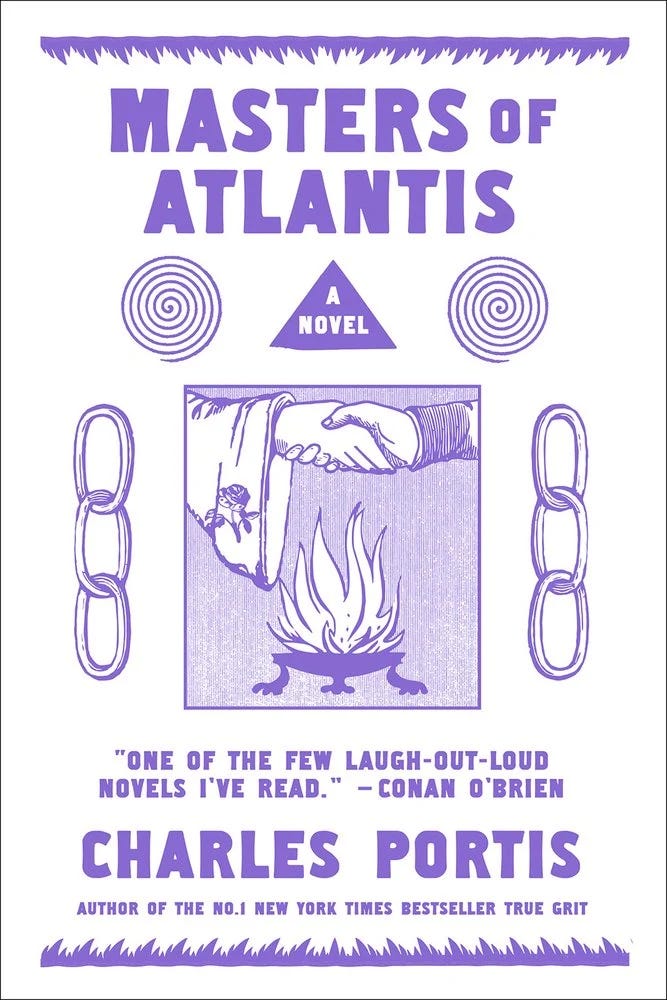
Masters of Atlantis (1985), by Charles Portis
Lamar Jimmerson is an army veteran who finds himself face to face with a strange vagabond while roaming the streets of Chaumont immediately after the end of World War I. The man sells him some texts full of inscrutable riddles and esoteric diagrams that he says represent ancient wisdom from the lost city of Atlantis, jealously safeguarded and passed down by great masters over the centuries. Lamar Jimmerson buys in immediately and, after gadding about in Malta in search of one of these shadowy masters, he meets an Englishman man named Sir Sidney Hen and together they found the Gnomon Society. Lamar takes on the job of growing the society in the United States and founds a temple somewhere in Indiana, located among a mess of highway overpasses, and eventually pillars start to spring up across the United States. Masters of Atlantis is the story of all the oddballs, rubes, would-be grifters, and true believers who make up the Gnomon Society and are central to its growth into, well, into something.
I read the vast majority of this book on a Southwest Airlines flight from Las Vegas to Pittsburgh, seated next to a man who spent most of the the trip watching Fox News on his tablet, while constantly rubbing his belly with his left hand using his right hand to flip off the screen whenever Chuck Schumer, Barack Obama, or any other democrat flashed on the screen. While the tenets of Gnomonism and the movement’s adherents seem to exist in a world beyond ideology, Portis’s work has its finger squarely on the pulse of the United States and its violent and tacky political culture, filled with portraits of the kinds of characters I imagined my seat-mate to be: paranoid rubes who imagine themselves to be the smartest men in the room, able to see past the veil into the greater conspiracies of our time.
In trying to describe the tone of Masters of Atlantis to a friend, I told him to imagine if Paul Thomas Anderson’s The Master had instead been adapted by the Coen brothers. Which is an odd way of describing it, because they did adapt another work of Portis’, True Grit. This novel also feels like it could be a cousin of another book I read and covered here recently, Robert Coover’s The Universal Baseball Association, in that most of the humor comes from a sense of dramatic irony, from the massive gulf between how seriously the characters take themselves, the loftiness of their ambitions, and the griminess of their circumstance and the complete inanity of what they believe in.
What Popper did was transform the Gnomon Society. Having gained the confidence of the Master, he was able to persuade him that they must broaden their appeal. The way to do this was to relax the standards. The Codex Pappus, for instance, was much to difficult for beginners and should be revised. There was too much memory work for the ordinary man; the staggering volume of this stuff must be reduced. Only in this way could the Society expect to grow and become a force in the world.
Mr. Jimmerson said, “And how would you go about this, Austin?”
Popper was turning through the pages of the Codex. “The first thing we must do, sir, is get rid of some of the triangles.”
“You would do away with the symbolic forms?”
“Oh no, not all of them. I would keep the Cone of Fate. Under no circumstances would I tamper with the Jimmerson Spiral.”
”But you think there are too many triangles? The simplest of polygons?”
”Far too many, sir, for the people I have in mind. Do you remember in school how hard it was to get anyone to join the Geometry Club?”
”I don’t believe we had a Geometry Club in our school.”
”Neither did we but you see what I mean.”
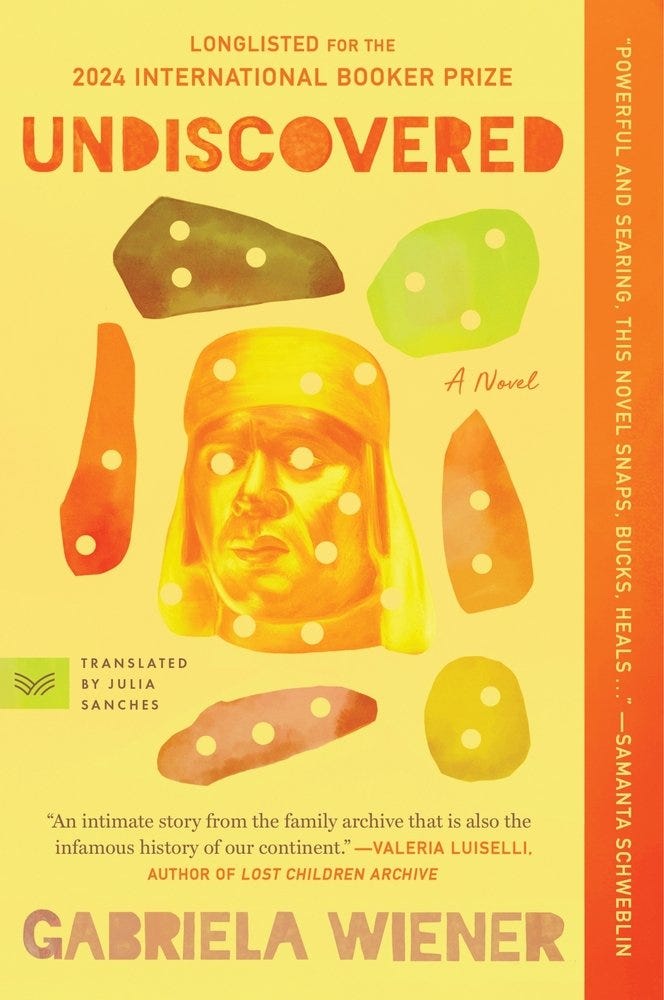
Undiscovered (2022), by Gabriela Wiener, translated from the Spanish by Julia Sanches (2023)
Undiscovered opens with the writer, Gabriela Wiener, walking through a museum in France filled with artifacts that were pillaged from Peru by her ancestor, the Austrian-French explorer, Charles Wiener. From there, the novel becomes an exercise in unpacking, writ large. Wiener unpacks Charles Wiener’s legacy, and what it means to be the indigenous descendant of this figure of white supremacy. She unpacks what it meant for her father, who was a dyed-in-the-wool Marxist and whose recent death she is grieving, to maintain anti-colonial commitments and yet express pride for this ancestor. Wiener unpacks the judgment she feels towards her father, a serial philanderer, while also considering her own polyamory. She unpacks the dynamics of her own throuple, in which she, her indigenous husband, and her white girlfriend all share a bed in their house in Spain. She unpacks what it means to cheat on her polycule when she pursues a secret relationship with a younger man while in the throes of grief.
There is a lot of unpacking that goes on, and maybe not so much sorting of things once they have been removed from their boxes and suitcases. It’s a book with more questions than answers. None of this really bothered me. It feels natural and I suspect any attempt to cleanly synthesize all this would be deeply unsatisfying, so I admire how messy Wiener lets everything get, her willingness to ask the next question without waiting for an answer to the last one.
For its subject matter, Undiscovered is a relatively light book. Wiener is funny and her family and personal life makes for good comedy. In one section, she recalls the time in which her father carried on an affair with another woman — perhaps the worst kept secret in her family — by traveling across town to his mistress’ house in an eyepatch, pretending to be another man. She treats her family’s history with an irreverence that osscilates back and forth between rage and healthy disdain:
But Wiener failed. Worse yet, he left clues on his map and an approximate location that helped Bingham reach Machu Picchu, because you never know who you’re working for. “I was informed of other cities, Huayana Picchu and Machu Picchu, and decided to make one final trip east before continuing south,” he wrote of the detour that took him to lesss important ruins, far from the most extraordinary find in the history of Peru. Missing something by a hair doesn’t make for a good story, In fact, of all the ways a person could fail, this one is especially frustrating. The kind of legacy nobody wants to claim.
Wiener drew a detailed map of the Santa Ana valley based on directions he got from locals, which included trail markers and came very close to the actual route, but then took a wrong turn and wound up discovering nothing, which meant he didn’t get a medal for stumbling across a monument built hundreds of years ago, or the chance to plant his little flag and sing “La Marseillaise.”
He wasn’t as lucky as his great-great-granddaughter, who in the late twentieth century commemorated the end of her journey by taking a hit from an apple pipe, grateful for the staggering view of the lost city of the Incas, which emerged green and rocky through the fog. All this after walking up peaks that rose 5,000 meters above sea level and down paths through the sacred valley, after several day son the Inca Trail and many kilometers of forest, after sleeping under starlit sky beside her closest friend, whose tits she was dying to touch. It’s safe to say that despite everything, I made it to Machu Picchu before Charles Wiener. I, quite simply made it. He did not.
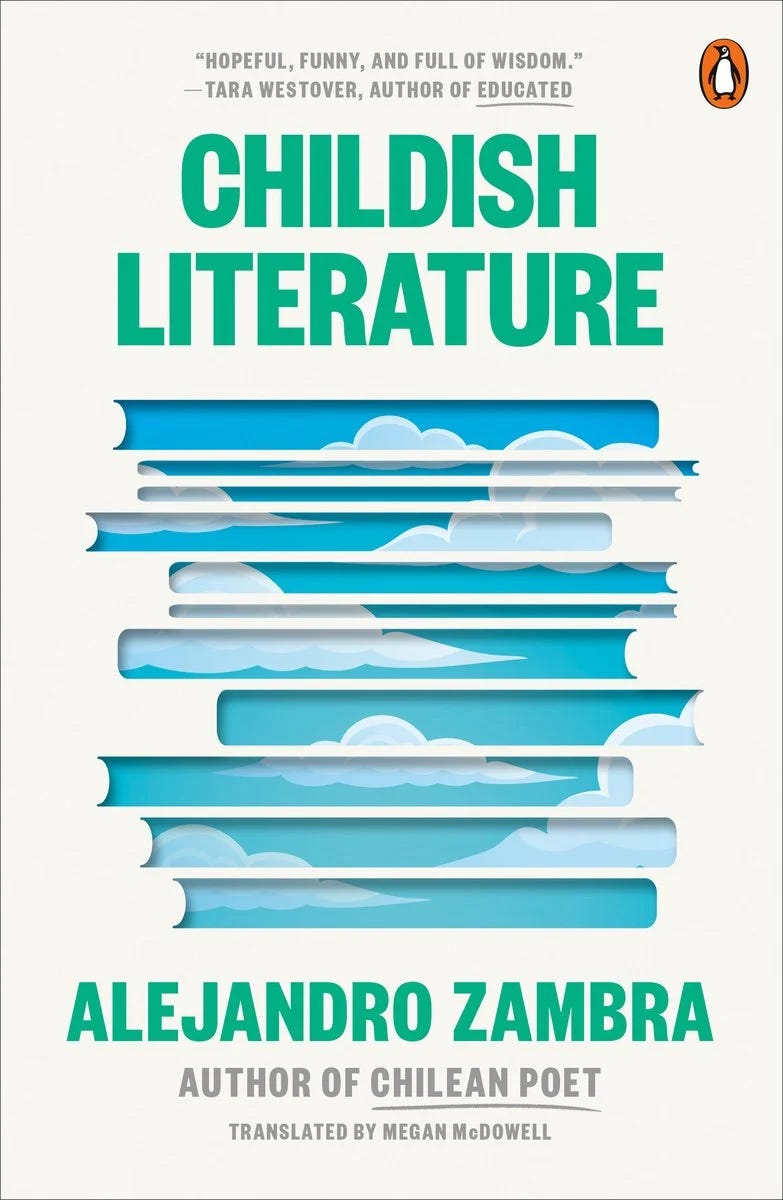
Childish Literature (2023), by Alejandro Zambra, translated from the Spanish by Megan McDowell (2023)
Childish Literature is a collection of short pieces written by Alejandro Zambra after the birth of his son. Split in two neat halves, the first explores the relationship with his infant son and his emotions regarding parenthood, while the second reflects on the writer’s own childhood and the ways in which his complicated relationship with his father changed after the birth of his son.
For as thematically narro
w as the works in here are, they feel varied. There are crónicas and goofy, Sedaris-esque personal essays, like the one about how Zambra missed an infant first aid course to try and treat his chronic migraines with psilocybin (you can read this one for free the Paris Review’s website). There are fictional (at least they read like they are fictional) short stories about navigating childhood friendships across different living circumstances. Perhaps my favorite are these diary entries full of daily observations from his baby’s first year of life, which look like poetry:
321
”What’s past is prologue.” Well, I guess I do. I rewrite the prologue, then, to the infectious beat of the rocking chair
352
You wake up on my chest and try to smooth my hair with both hands.
364
A son and his father share the lounge chair and invent some less serious clouds.
I read most of this book on a beach in New Jersey, and the book was well-suited to this kind of reading. It has a lightness, albeit a very different lightness to Wiener’s Undiscovered. At one point, Zambra shares a story about getting drunk with his Italian editor. With the loose lips of someone who has had a few, she tells him that he should give up writing serious, adult novels and just write children’s books. She is obviously mortified the next day at having said this, but he takes no offense at the remark and seriously considers the advice. There is an earnest simplicity to Zambra’s writing and voice that makes me understand where the editor is coming from, and far from being a marker of a lesser or unserious literature, it is something I imagine a lot of writers would kill for. If Zambra were to ever write a children’s book, I would read it.
Interview With the Vampire (1976), by Anne Rice
I imagine this book doesn’t need much of an introduction to many people, but it’s about Louis, a slave-owner in New Orleans at the end of the 18th century, who is turned into a vampire by a man named Lestat. Lestat relishes life as a vampire, he loves hunting and feeding on humans, but over the 200 years of the novel’s plot, Louis never loses his love for humanity and mortality. Much happens. They turn Claudia, a young orphan into a vampire. Claudia and Louis betray Lestat and set him on fire. They travel to central Europe and France. There is some action, but really, there is a lot of moaning on Louis’ part about existential malaise and the inherent evil nature of the vampire.

You may be able to tell that I didn’t love this book. I acknowledge that, conceptually, the unbearable pain of being immortal—yet condemned to feed on human blood for eternity—is likely the most interesting aspect of the vampire story as a genre. Rice, via a lot of monologuing on Louis’ part, squeezes every bit of juice from that conceptual lemon and then just keeps squeezing. It is frustrating because Rice is a good writer, there are beautifully written passages and compelling action scenes, but they are few and far between.
I did watch the 1994 Neil Jordan adaptation, with Brad Pitt, Tom Cruise, and Kirsten Dunst after finishing the book. I found Louis even more tiresome in the film. The miserable woodenness of Pitt’s performance, opposite a Cruise who is having time of his life, maybe even distorted my memory of the novel. But this is not a film newsletter.
On-Deck Circle:
I’m back to my book club books next. NYRB Classics sent the following titles out over the last three months:
Lives of the Saints (1985), by Nancy Lemann
Light While There is Light: An American History (1993), by Keith Waldrop
G. (1972), by John Berger