
May Books I
Jane Smiley, J.G. Ballard, Gabriel García Márquez

A Thousand Acres (1991), by Jane Smiley
What is it about rural novels that draw me in? A few years back I went through a heavy Annie Proulx phase, and one of the more recent books that sticks stubbornly in my memory is Gerald Murnane’s The Plains, a novel about the blank landscape of the Australian Interior. The desert stories of Lucia Berlin resonate with me. William Maxwell’s So Long, See You Tomorrow. I suppose rural novels and novels about farmers function like westerns, in that from page one they are immediately dealing with myths about colonization, Manifest Destiny, and the creation of this country (in Murnane’s case, the colonization of Australia, that bizarro cousin of the United States), even if they don’t intend to.
A Thousand Acres is a feminist retelling of King Lear. The patriarch of a large farm in the American Midwest slips into dementia in his old age and draws up a cooperative scheme in which his properties are mortgaged to a banker and passed down to his three daughters and their husbands. This one decision unleashes hell and decades old fault-lines and trauma within the family are cracked open. The father and the daughters are at each other’s throats. With no work to do, he takes up the age-old hobby of drunk driving. Repressed memories of cruelty and childhood sexual abuse at the hands of the father come bubbling up and radiating out. From those revelations come suicides and murder plots within the family.
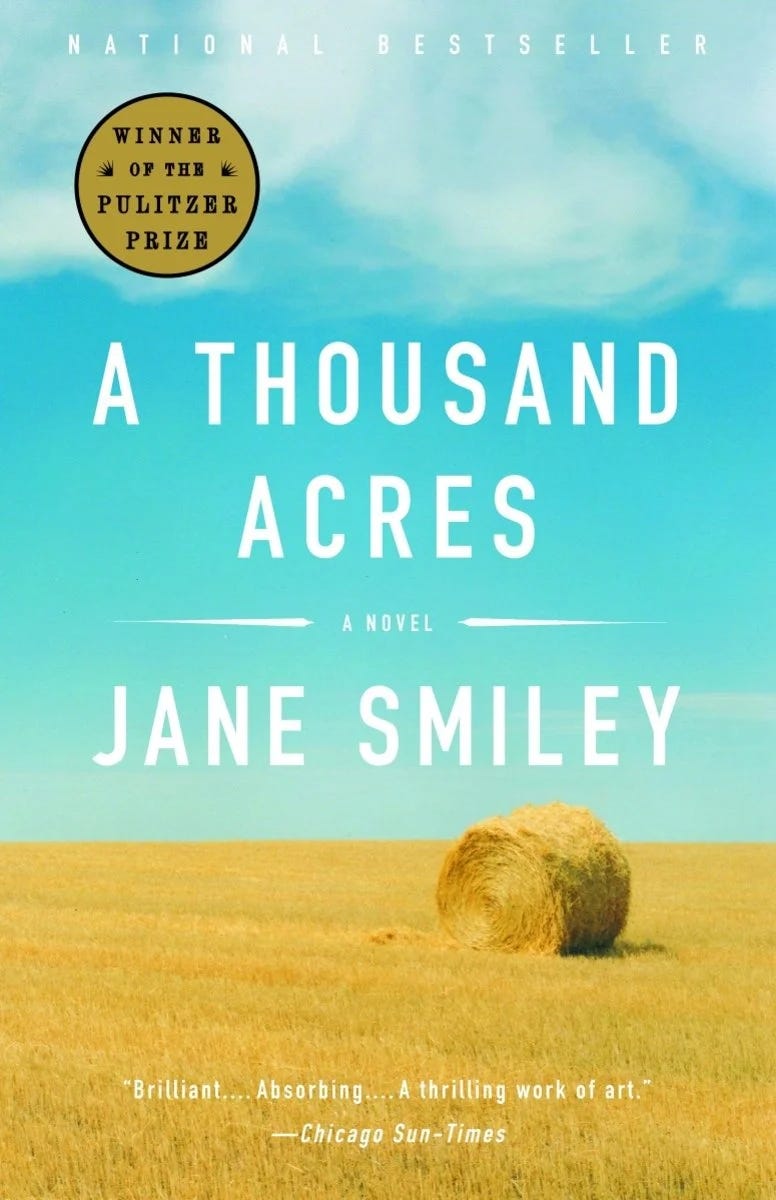
All of this is told through the first-person narration of one of the daughters, Ginny. From the get-go, I found Ginny’s voice to be inherently trustworthy, even as the character herself begins to fall apart and betray and plot against her family members. She has a wiseness that endears itself to me and there are moments in which the narration’s time signature changes and gains a sort of god-like omniscience and the present is revealed to contain within it a longer, geologic history:
In Zebulon County, though, my father’s thousand acres made him one of the biggest landowners. It was not that the farmers around us were unambitious. Perhaps there were those who dreamed of owning whole townships, even the whole county, but the history of Zebulon County was not the history of wealthy investment, but of poor people who got lucky, who were sold a bill of goods by speculators and discovered they had received a a gift of riches beyond the speculators’ wildest lies, land whose fertility surpassed hope.
For millennia, water lay over the land. Untold generations of water plants, birds, animals, insects, lived shed bits of themselves, and died. I used to imagine how it all drifted down, lazily, in the warm, soupy waters—leaves, seeds, feathers, scales, flesh, bones, petals, pollen—then mixed with the saturated soil below and became, itself, soil. I used to imagine the millions of birds darkening the sunset, settling the sloughs for a night, or a breeding season, the riot of their cries and chirps, the rushing hough-shhh of twice millions of wings, the swish of their twiglike legs or paddling feet in the water, sounds barely audible until amplified by millions.
A Thousand Acres deals plainly with the patriarchal violence of capitalism and our patrilineal society and economy while seemingly ignoring other aspects of this country’s history. The meat of the novel takes place at the end of the 70’s and it feels purposeful, as if Smiley deliberately chose a moment in which the figure of the farmer as a kind of American everyman became less a reality and more a political myth. It’s a moment when land ownership begins to fall into the hands of corporations and we see the onset of cultivation not for food but for byproducts. It’s one of the whitest novels you’ll ever read and issues of slavery, land theft, and genocide don’t figure into it explicitly. But all of this hovers over a novel in which the curdled, rotten nature of the American project has begun to leak out of the facade of wealth and progress.
Running Wild (1988), by J.G. Ballard
A psychologist is brought on by investigators to help solve a grizzly massacre in a gated community outside London, in which all the adults at home that day were murdered and all their children vanished. With the help of a jaded sergeant posted at the scene, he quickly realizes that the children themselves are the culprits.
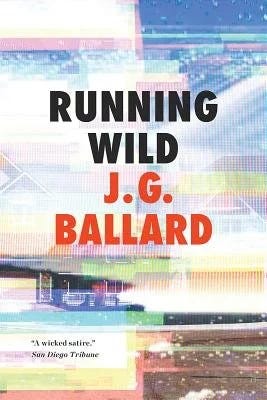
I don’t feel too bad spoiling that twist, Ballard telegraphs it from the very beginning and it’s really more of a howdunnit, sort of like a Columbo episode, only not as fun. And the book also wasn’t that good. There is a bloodless quality to it, even when describing gruesome murders. I’m sure it’s deliberate, the clinical language of the narrator who deals things as a matter of profession, but it also gives the book the feeling of a rough draft or an outline that’s not fully fleshed out. It feels like a variation on a theme — the wealthy killing each other within their gilded castles — that Ballard explored in High-Rise a decade earlier with more success, and in probably a dozen other books that I haven’t read.
I also found the narrator’s explanations for the murders to be a little pat, with an unconvincing edginess to them reminiscent of a bad punk song:
“But one last question. I agree the children killed their parents, and they carefully planned it together. But why? There was no evidence of sexual abuse, no corporal punishment getting out of control. If there was some kind of tyranny here it must have been one of real hate and cruelty. We haven’t found anything remotely like that.”
“And we never will.” The Pangbourne children weren’t rebelling against hate and cruelty. The absolute opposite, Sergeant. What they were rebelling against was a despotism of kindness. They killed to free themselves from a tyranny of love and care.
Maybe it’s because I unwittingly read two consecutive books in which a father rapes a daughter before this, but I found the general thrust of Running Wild to leave me cold when I suspect it was meant to be eerie and provocative.
Leaf Storm (1955), by Gabriel García Márquez, translated by Gregory Rabassa (1972)
A son, a mother, and a grandfather — three citizens of Macondo, that famous, fictional company town from One Hundred Years of Solitude — spend an afternoon prepping the body of a doctor for burial. The doctor was a shut-in and ostracized by the townspeople and now they resist the protagonists’ attempts at giving him a Christian burial. The three generations of this family take turns telling us the story of the doctor, of their lives, and of the rise and fall of Macondo in these lovely circular stories that link up and layer on top of each other.
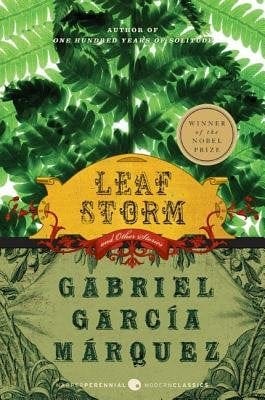
For those who have read and enjoyed One Hundred Years of Solitude I think there is a lot to get out of Leaf Storm, in much the same way you might enjoy listening to the demos and bootlegs of a favorite album you like. It feels scrappy at first, and maybe a little slow, but slowly the narrative patterns and circles you remember from García Márquez’s magnum opus start to come to the surface. Leaf Storm’s circles intersect at a few repeated sentences that serve as fulcrums on which the novel rests and tilts. They are ordinary, everyday sentences that feel a little bit more bizarre each time they are repeated, like this set of lines that pop up two or three times to signal a change in narration:
‘Do you think something might happen?’ she asks. And my grandfather lifts his chin from his cane and shakes his head. ‘At least I’m sure that the rice will be burned and the milk spilled in lots of houses.’
Beyond questions of structure, we also see get to see Macondo begin to take form as the dusty, haunted, half-abandoned city it would later become in other works:
When we went in the back way we found the ruins of a man abandoned in the hammock. Nothing in this world can be more fearsome than the ruins of a man. And those of this citizen of nowhere who sat up in the hammock when he saw us come in were even worse, and he himself seemed to be covered by the coat of dust that covered everything in the room. His head was steely and his hard yellow eyes still had the powerful inner strength that I had seen in them in my house. I had the impression that if we’d scratched him with our nails his body would have fallen apart, turning into a pile of human sawdust. He’d cut his mustache but he hadn’t shaved it off. He’d use shears on his beard so that his chin didn’t seem to be sown with hard and vigorous sprouts but with soft, white fuzz. Seeing him in the hammock I thought: He doesn’t look like a man now. Now he looks like a corpse whose eyes still haven’t died.
Much is made of Gabriel García’ Márquez’s role in the creation and proliferation of magical realism, at least in the Latin American tradition. You certainly see the fantastical element most obtusely in stories like “A Very Old Man with Enormous Wings”, but when I think about his work and what sticks with me about his talent as a writer is his subtlety. The magical realist elements in the works I admire by him are muted. I admittedly don’t remember a whole lot about One Hundred Years of Solitude, but I remember the opening scene about seeing ice for the first time, and I remember that one woman who eats dirt. In those moments, and in the above excerpt, there is nothing inherently fantastical about what is written. The alchemy occurs in the way the narrator perceives the world, in the way things feel slightly askew or out of place.
The On-Deck Circle:
I’ll have another newsletter out in a couple days on the books that New Directions has been sending me in the mail over the last few months:
The Disappearing Act, by Maria Stepanova