
November Books
Manuel Puig, Elena Ferrante, Jenny Odell, Hebe Uhart, Helen DeWitt

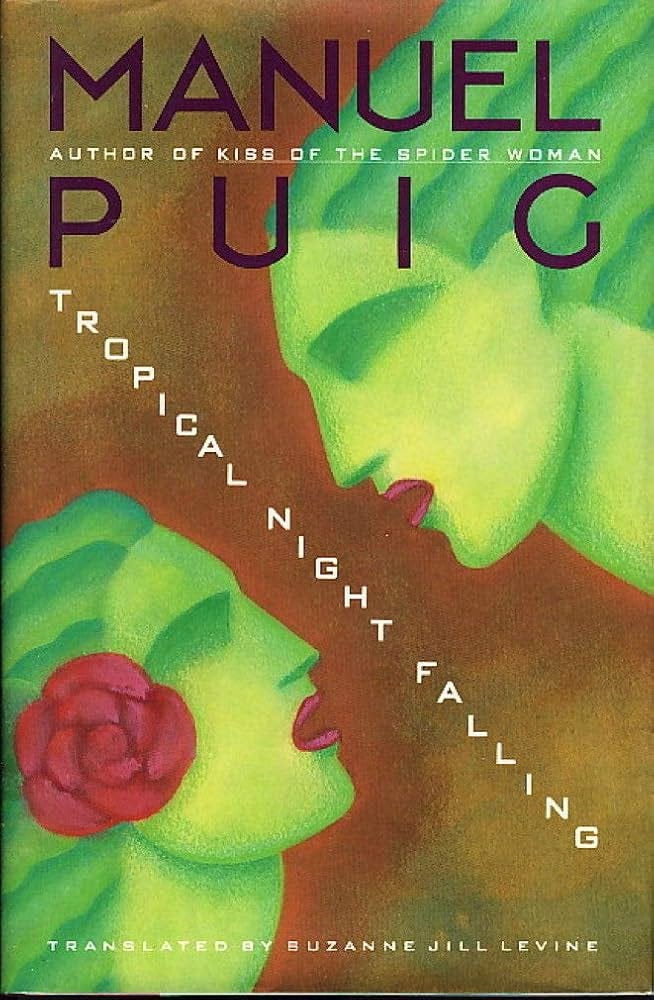
Tropical Night Falling (1988), by Manuel Puig, translated by Suzanne Jill Levine (1991)
Tropical Night Falling was the final book Manuel Puig published before his death in 1990. Like his most famous work, Kiss of the Spider Woman, it is comprised mostly of dialogue. At the center of the novel are two elderly porteñas who have found refuge from the cold Buenos Aires winter in Rio de Janeiro. They pass the time gossiping about a neighbor, a middle-aged woman also from Buenos Aires. This woman is a psychologist and has been venting to one of the women about an ill-fated relationship she is pursuing with a widower. This neighbor is obsessed with this schlubby man and waits by the phone all day for him to call. One of the old women is sympathetic to the neighbor, the other is judgmental. As the neighbor’s obsession deepens, they both find themselves drawn themselves into the drama of her life, and they find not just distraction but meaning in her drama.
For much of the novel, what keeps the story moving along is a series of ambiguities. I found myself reading on because I wanted to better understand the hazy contours of their gossip. Like a lot gossip among friends, there is meanness and concern in equal measure, and throughout the novel you can see these two feelings pile up on either side of the plot’s equation. There is also the question of what it all matters. What influence does the gossiper have over the plight of the gossipee. At what point does a personal drama become tragedy, or at least significant enough for gossip to be in poor taste.
Puig seems to deliberately play with this question. The book dips into the realm of tragedy before pulling back. The tragedy constantly seems to be happening off-screen. The book ends with the following passage, a scene that is almost laughably trivial:
The only irregularity recorded during the flight took place before landing in Rio de Janeiro, where the passenger from tourist class N. de Angelis, already assigned special attention because of her advanced age and high blood pressure, was disembarking. Her salt-free dinner had been served to her accordingly, and the passenger expressed satisfaction with the treatment received. Shortly before landing in Rio, stewardess Ana María Ziehl approached me with a dilemma: She had noticed the above-mentioned passenger hiding in her ample handbag on of our flight blankets. Stewardess Ziehl had not dared to point out to the passenger that the blanket was the property of Aerolíneas Argentinas, given the passenger’s age and condition, but she did mention it to the writer of this report. By common agreement it was decided to ignore the incident. In any case, evidence of the episode is recorded to illustrate the problem of the constant disappearance of blankets. The landing in Rio was particularly smooth, and the passengers applauded the captain’s skill.
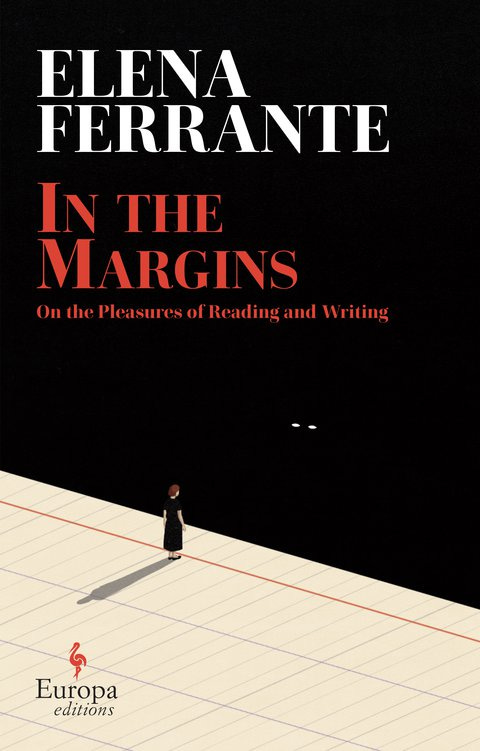
In the Margins: On the Pleasures of Reading and Writing (2021), translated from the Italian by Ann Goldstein (2022)
The first of a few non-fiction books I read in November, I must admit that I have forgotten most of what Ferrante gets into here. It’s a very short book, adapted from a lecture she delivered by way of an intermediary, and I read it in a single morning, and as such, it seems to have left my memory as quickly as I read it.
Rummaging through my memory, and looking back at my underlines and tabs, I think the section that I found most interesting was the one about the long process of writing the Neapolitan Novels. Ferrante matter-of-factly takes us under the hood and shows both the inspirations and the anxieties that marked and affected the creation of Lenù and Lila.
A few of the intellectual ingredients that went into the project were the works of the feminist philosopher Adriana Cavarero and Sexual Difference: A Theory of Social-Symbolic Practice, by the Milan Women’s Bookstore Collective. Here Ferrante describes the exact elements from those works that informed her writing:
I had read Sexual Difference many years earlier and hadn’t really noticed Emilia and Amalia. But Cavarero extracted those pale figures of women from the two pages or so that concerned them and spoke about them with great sensitivity and intelligence. She wrote about the “narrative character of female friendships.” She wrote—listen to this—about the “intersection of autobiographical narrations that insure the result of the reciprocal biographical activity.” She wrote: “At work… is a mechanism of reciprocity through which the narratable self of each woman passes to auto-narration so that the other may know a story that she can in turn tell others, certainly, but most important, again tells the woman who is its protagonist.” She summarized: “Put simply, I tell you my story in order to make you tell it to me.” I was enthusiastic. It was what I—not putting it simply—was trying to write in my draft of an endless novel centered on two women friends who weave together the stories of their experience […].
I find the concept of constructing one’s narrative vis-à-vis another human, be it a friend or loved one, so interesting. Building an identity in relationship to others is so messy and potentially destructive, yet an unavoidable part of life, and Ferrante’s deep dive into this dynamic is what made the Neapolitan Novels so remarkable.
It’s also interesting to see the choices not taken when it came to writing the Neapolitan Novels:
The “I” who writes and publishes is Lenù’s. Throughout the Neapolitan Novels, we never know anything of Lila’s extraordinary writing except what Lenù summarizes for us, or the little that emerges in Lenù’s writing. I said to myself at a certain point: you should make up some passages from Lila’s letters or notebooks. But it seemed to me inconsistent with Lenù’s rebellious inferiority, with her deluded autonomy that aims, in a process as complex as it is contradictory, at absorbing Lila by taking away her power, and empowering Lila by absorbing her. And, besides—I confessed when the book was going well—would I who write along with Lenù, I, the author, even be able to create Lila’s writing? Am I not inventing that extraordinary writing just to describe the inadequacy of my own?
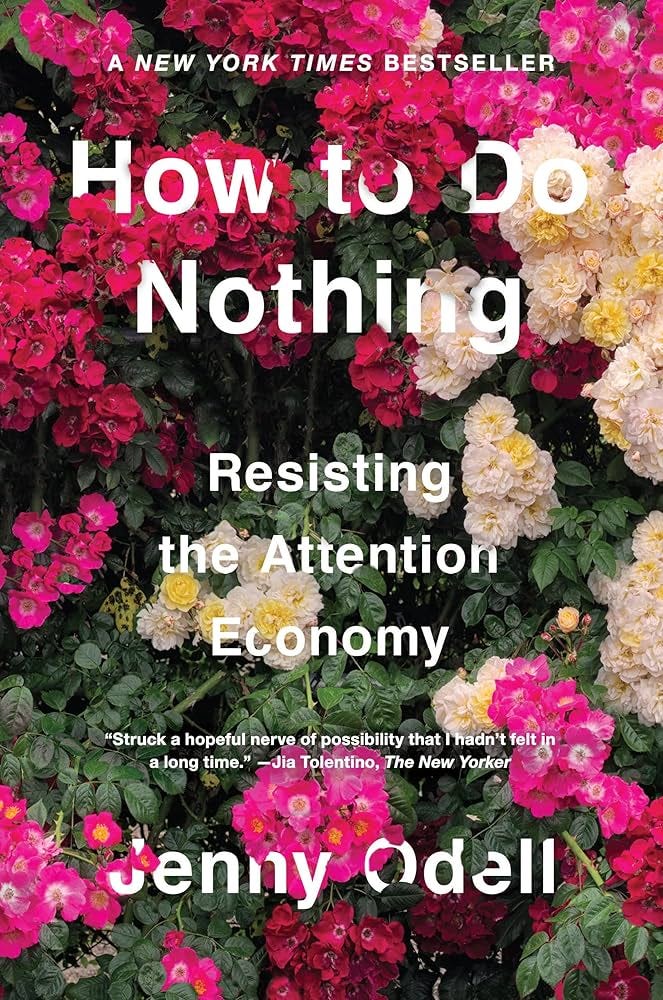
How to Do Nothing (2019), by Jenny Odell
Normally I am very audiobook adverse, but I mostly listened to this book while walking the dog in the morning, which felt somewhat fitting for a manifesto about doing nothing.
I found myself impressed by the needle that Odell threads in defining her nothing. Odell’s nothing is anti-capitalist and against the concept of productivity as we understand it, but she is careful to avoid advocating for dropping off the grid and becoming a hermit, disconnected from the world around us. Odell values logging off and staying quiet and paying attention in a way that is both regenerative and nourishing, but also keeps you connected to your fellow humans.
This was a strange listen in that I was already fully bought into the benefits of doing nothing going into the book. In fact, I am pretty good at doing nothing, if I do say so myself, so I felt as though I were getting less from How to Do Nothing than someone who is addicted to work or social media might. I found the book most interesting and instructive when Odell turned to hyper local examples, like the Rose Garden by her house in Oakland, or delved into labor history, as when discussing the history of striking longshoremen in the Bay Area and the long, complicated history of communes in the 20th century. I found Odell least compelling when referencing dusty old philosophers, like Diogenes, or well-trodden literary analogies, like in Melville’s Bartleby.
All in all, I think my experience reading and listening to the book was one of a choir being preached to. I suspect that might also be the case for a lot of readers of this newsletter, but its still worth a read.
A Question of Belonging (2020), by Hebe Uhart, translated from the Spanish by Anna Vilner (2024)
The vast majority of the crónicas in this collection read like odd takes on the travelogue. Instead of narrating big adventures or long voyages oversees, Uhart tends to stay close to home, visiting small towns outside of Buenos Aires. And instead of a list of sites seen and profound experiences, most of her stories feature small conversations had with locals or fellow travelers about the mundanities and small struggles of life and travel. This passage seems to be the purest essence of the kind of small places Uhart prefers to visit and the way she writes about them:
When I got off the bus, I asked the young woman behind the counter, “Could you please recommend a clean and affordable hotel with a private bathroom?
A man was by her side, chatting quietly with her. I was the only passenger who had gotten off at Tapalqué.
The man said, “We don’t have any hotels here; we used to have one, but the mayor couldn’t decide what to do with it, it’s been under construction for the past four years. You should bring it up with the mayor.”
I glanced at the bus station: it was no bigger than my living room, without a newspaper or cigarette kiosk, or even a café, so I said, “No cafés at this terminal?”
“You ask for a lot,” the man said, and the young woman at the ticket counter said kindly, “You can stay at Mary’s house, she’s a good person.”
The man said, “Mary went to Buenos Aires for the weekend.”
“Then you could go to Lola’s instead,” the young woman said courteously.
I find Uhart’s voice to be incredible. She is funny in a dry, plainspoken manner, avoiding ten dollar words and purple prose in a way that communicates a supreme sense of confidence. And for someone who could be described as a travel writer, working in a genre that has an uncomfortable tendency to otherize even as it reaches towards some sense of human universality, she has an incredible knack for both acknowledging her perspective and moderating it, knowing just when to fade the “I” in and out of her narratives.

The stars of these crónicas are the people she meets on her travels, often lightly peculiar and with their idiosyncracies, like Father Werner, a figure from her childhood who she bumped into on a train to Bolivia. It feels like Uhart manages to write an entire novel about this man in the space of a few paragraphs by picking up and putting down threads of narrative at will, sentence after sentence:
While roaming the other end of the train, I found Father Werner in second class, surrounded by countless baskets and boxes. I was ten the last time I saw him, but he looked at me as though it had been only yesterday. Back then, when he was the assigned priest of Moreno, town gossips said he had been exiled from his former church. He was known for his peculiar habits: to reach the altar more quickly, and to avoid traversing the room where the sacristan slept, he made a breach in the other wall and would enter bowing, his ornaments in hand. He lived off bananas and chocolate, which he would eat while riding his bicycle everywhere, so he wouldn’t waste any time.
When my brother was twelve or thirteen, he stole money from the house and gave it to Father Werner — it was for some experiments he was conducting by the riverbanks to find a cure for cancer. While he was down there, he would occasionally study the flora and fauna as well. He visited us at home one day and told my mom the story of how he escaped Nazi Germany. He said he had joined a cycling race, disguised as one of them. If he really did escape as a cyclist, I wondered, where did he put his clothes and suitcase? Every traveler has a suitcase, but it seemed that those who fled the war were different from the rest of us. My family thought of him as a the hero of a Greek tragedy, and we were like the chorus watching him with reproach, admiration, and awe. He dipped a vanilla cookie into a glass of liqueur while he told his incredible story and drank the whole concoction down just like that. He probably thought that everything mixed up in the stomach and that as long as it wasn’t poison, it was edible. But these were people who lived through the war, so of course they were different. My brother was forgiven for taking the money; in the end, it had been for noble cause.
Some said Father Werner was banished from Moreno because he let his parishioners wear shorts to mass […]
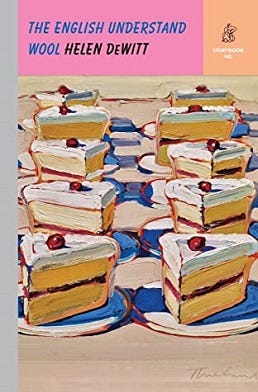
The English Understand Wool (2022), by Helen DeWitt
The first third or so of this story, published as a standalone text as part of New Directions’ Storybook ND Series, is funny but completely bewildering. At first, it seems to be about nothing more than fine living and expensive things:
—The English understand wool.
My mother sat on a small sofa in our suite at Claridge’s, from which the television had been removed at her request. She held in her lap a bolt of very beautiful handloomed tweedwhich she had brought back from the Outer Hebrides. She had in fact required only a few metres for a new suite.
It carries on like this for a dozen or so pages, the narrator retelling lessons in shopping, commerce, and servant management that she learned from her mother:
The excursion to Scotland and then to London took place during Ramadan. It was her practice to spend Ramadan abroad, and to encourage my father to do so as well: Daddy always had any number of business trips on his plate, anad there was no reason a sufficient number should not be lined up for the appropriate time. The servants remained on full pay. They might stay in the riad in Marrakech or visit their families, as they pleased. It would be mauvais ton to be waited upon by persons who were fasting. It would be mauvais ton to make the exigencies of religion an excuse to curtail their salaries.
The narrator, Marguerite, is a famous and incredibly wealthy orphan, destined to inherit a fortune, who was kidnapped from her godparents at a young age and raised from childhood by her kidnappers. What we are reading is meant to be a tell-all autobiography, the rights of which have been purchased by a publishing house at an eye-watering sum. Her editor, Bethany, interrupts the text with emails pleading for her to open up:
Hi Marguerite
Thanks for the pages, they definitely give a feel for what she was like and that’s really helpful, but you don’t say much about your feelings. She seems to have been quite cold, how did you feel about that? Were you hurt? Did you feel you had nowhere to turn? Did it ever occur to you, maybe just for a second before you told yourself it was crazy, that she was not actually your mother? Also, you don’t say much about “Daddy”, but this must have been quite a strange relationship.
And so the rest of the story reads like a duel between Marguerite and Bethany. Marguerite appreciates the childhood she has had, regardless of who her rightful guardians are, and so she is totally incapable of writing the book that Bethany wants. She responds to her increasingly desperate emails with pages like this:
It is important to play tennis. If one is invited to a château or country house one must not put one’s hosts to the nuisance of arranging entertainment, one must be prepared to make up a party. It was straightforward to arrange lessons at the Royal Tennis Academy.
Without spoiling anything, it all comes to a head at the end when Bethany threatens to sue Marguerite over breach of contract.
It’s a fun, zany story with a meta-narrative — about writing, about publishing, about misbegotten books, about books that refuse to be written — that manages to stay completely unpretentious. It’s the first thing I’ve read by Helen DeWitt in years, the first thing since her bonkers and disturbing 2011 novel, Lightning Rods, in which a struggling salesman comes up with (and monetizes) the idea that problem of workplace sexual harassment can be solved with the hiring of undercover sex workers. This was obviously a lighter read and it has me wanting to read more DeWitt in a way that Lightning Rods did not.